Showing posts with label animals. Show all posts

Tuesday, April 28, 2015

Encyclopedias

What are Encyclopedias?
  • Encyclopedias provide a reader with a bunch of information on one specific topic. If students are interested in a certain topic, such as dinosaurs, oceans, animals, space, etc., and want to know everything about them, find an encyclopedia about it. Nowadays there are a number of great encyclopedias that are made just for kids, with a lot of pictures, fun facts, and bright pages!
Criterion for Quality and Selection:
  • My number one criterion for selecting an encyclopedia is appeal. Many students may see encyclopedias as another textbook, when they most definitely are not. The pages need to be appealing and eye-catching in order for the students to want to pick them up and read them.
    • Examples: bright pages, bold, clear fonts, correlating illustrations, fun facts, etc.
  • Organization is also extremely important when it comes to selecting an encyclopedia for my classroom. Since there is so much information in an encyclopedia there should be a clear table of contents and index for easy access to the content.
    • The content should also have some form of organization throughout the text, whether it's alphabetical or categorized.
Use in the Classroom:
  • The main use of encyclopedias in my classroom would be as a reference tool. If students were doing research, or just interested in a topic, I would point them in the direction of an encyclopedia. 
  • When starting a new chapter/section in the textbook that students have never learned about, pulling from an encyclopedia could be very beneficial. It is a different perspective from their textbooks, and most children's encyclopedias include more pictures and fun facts for the students to visualize and remember.
TEXT EXAMPLES:
Sabuda, R., & Reinhart, M. (2005). Dinosaurs: Encyclopedia prehistorica. Cambridge, MA: Candlewick Press.
  • Complex Text Level: 3rd - 4th
  • Grade Level Span for Read-Aloud: 2nd - 3rd
  • Major Themes:
    • Dinosaurs
    • Archeology
  • Worthy Qualities of Writing:
    • On every page there is at least 4 detailed dinosaur popups, including descriptions and the name of the dinosaur. This will get students really excited about reading the text and seeing what popup is on the next page.
    • The text includes pronunciations for every breed of dinosaur mentioned.
      • Triceratops (try-SAIR-uh-tops)
  • Support Needed:
    • Understanding the organization of the text. There are so many popups on each page it may be difficult for the students to know where to look first.
Spelman, L. (2012). National geographic animal encyclopedia. Washington, D.C.: National Geographic.
  • Complex Text Level: 3rd - 4th
  • Grade Level Span for Read-Aloud:
  • Major Themes:
    • Animals
    • Habitats
    • Protection of Endangered Animals
  • Worthy Qualities of Writing:
    • The beginning of the text provides a "How to Use this Book" page. There are example pages from the text with little explanation boxes and arrows pointing to the correlating pieces of the text.
      • This is great for young readers because they could become overwhelmed when reading an encyclopedia since there is so much information.
    • The first few pages of the text give general information about all types of animals before jumping into the bulk of the text.
      • Life cycles & babies, senses & communication, and homes & habitats. 
    • Animals are organized by taxonomy (mammals, amphibians, fish, etc.) and includes their general and scientific names, along with fact boxes that explain habitat, diet, lifespan, and size.
      • There are also fun facts by some of the animals detailing if they are the smallest, the fastest, or the tallest!
  • Use in the Classroom:
    • When doing research on endangered animals, the students could use this text to figure out which animals are endangered. They could also look at the animals' habits to make educated guess as to what is caused their endangerment.
    • This text would also be great to have students explore prior to going on a field trip to the zoo. They could get to know the animals and where their natural habitat is located before seeing them on the field trip.
  • Support Needed:
    • Understanding the different taxonomy of animals.
      • Preteaching about the differences between mammals, amphibians, fish, reptiles, insects, and birds. This will help the students locate the desired animals quicker.

Sunday, April 26, 2015

Nonfiction Poetry

What is Nonfiction Poetry?
  • Nonfiction poetry is the exact same as every other kind of poetry with a bonus quality, it is poetry about education, realistic topics. When most people hear the word poems, they think of love, but that isn't always the case. When science, social studies, or even math is presented in poem form it is a new and fun way to introduce young students to the subjects. Nonfiction poetry presents everyday content in a different, and intriguing form for all ages of readers.
Criterion for Quality and Selection:
  • Poetry can range in difficulty, even within a single text, so it's important as a teacher to read through first and pick out what is appropriate for the students. We don't want students to start reading a text and understand it, then get to a passage they aren't able to comprehend.
  • Since poetry is something most students aren't drawn towards, finding text that is appealing to them is important. There is poetry that covers all types of subjects and interests to please all the students in the classroom. Finding that interests can get the student exciting about reading, and wanting to read.
Use in the Classroom:
  • Poetry is a great avenue to go down when working on comprehension with students. It presents material in a different way, and really makes students analyze what they are reading. Poetry is also great for comprehension because poems are usually short, so students won't become too bored with them and give up.
  • Going along with the poems usually being short, helps with students working on fluency. With short passages, it will take the students less time to read them, and they can then reread them more times, thereby improving their fluency.
  • Pieces of poetry would be great to assign to advanced students during reading times because it requires deeper thinking for understanding. 
TEXT EXAMPLES:
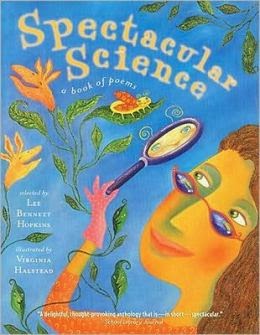
Hopkins, L., & Halstead, V. (1999). Spectacular science: A book of poems. New York, NY: Simon & Schuster Books for Young Readers.
  • Complex Text Level: 2nd - 3rd
  • Grade Level Span for Read-Aloud: 1st - 3rd
  • Major Themes:
    • Life Science
    • Earth Science
    • Physical Science
  • Worthy Qualities of Writing:
    • Large, bright illustrations that correspond with the poems on each page.
    • Great text features such as, a table of contents to find specific topics, page numbers, easy to read font, and bold, different colored titles for every poem.
  • Use in the Classroom:
    • Since there are so many different topics, (rocks, dinosaur bones, and seeds) I would use them to introduce new material as they came up during the year. It would be a great way to ease students into the content.
  • Support Needed:
    • Preteaching words that are associated with the different areas of science such as, protozoans, prism, metamorphosis, magnifying, glaciers, and geysers.
    • Preteaching the different structures of poems.
      • Sentences may be split up into multiple lines.
      • Some lines start with capital letters, even though they are the middle of a sentence. 
      • Rhythm in the writing by having rhyming words at the end of lines.
Worth, V., & Jenkins, S. (2007). Animal Poems. Vancouver, BC: Douglas & McIntyre.

  • Complex Text Level: 3rd - 4th
  • Grade Level Span for Read-Aloud:
    • 2nd - 3rd
  • Major Themes:
    • Animal Characteristics
    • Different Animal Families
  • Worthy Qualities of Writing:
    • Extremely detailed illustrations that correlate precisely to the text.
      • Cover picture example text: "Thicket of its own thorns" "Flower out of that cold bower of spines."
    • As I mentioned with the text examples above, each animal has text that gives detailed characteristics in a way that allows students to visualize the animals if no illustrations were provided. 
  • Support Needed:
    • Some of the characteristics given for each animal, could be difficult for students to decipher and comprehend. The names of each animal are given along with an illustration, so students can refer to that as well.
      • "Their hollow veils and trailed clappers peal eternal knells" -Jellyfish
      • "Not like my shadow I dislike, but that sad sunlight creeping so weak across the winter-weary snow" -Groundhog
    •  Preteaching some of the more difficult terms: clamber, latticed, knells, and sumptuous.